When Should a Watts Valve Be Repaired or Replaced?
Repair a Watts pressure-reducing valve when a serviceable adjustment or part can restore steady control; replace it when wear or damage prevents reliable regulation. Weak flow at several fixtures or a gauge that shifts unexpectedly deserves a proper check before you buy a valve. A single symptom does not prove the regulator is at fault.
Our crew checks how the valve responds and looks for other causes before recommending work. In Vermont, travel and site access can affect how a repair visit is planned: a home near Bennington Battle Monument may have different access considerations than a property near Missisquoi National Wildlife Refuge.
Around Otter Creek Falls in Middlebury, too, your service location helps us plan the visit. Ask us to explain the test results, whether the existing valve can be serviced, and what evidence would justify replacement.
What does a Watts valve control?
A pressure-reducing valve limits incoming water pressure to protect plumbing and help fixtures receive steadier supply. If several taps weaken at once, or pressure changes sharply, the valve may be sticking, clogged, or worn but those symptoms can also come from elsewhere in the system.
We start by taking readings and checking the valve rather than swapping parts on a hunch. That distinction matters.
A home near Champlain College in Burlington, for example, may have a municipal supply, while another Vermont property relies on different plumbing arrangements; identify the supply before interpreting the test.
Church Street Marketplace is a familiar Burlington landmark, but the useful lesson for a homeowner is practical: a symptom at one fixture differs from a pressure problem affecting the whole building. Heavy rain can overwhelm drainage around foundations, so if the utility area is wet, mention it before work begins and keep water away from electrical equipment. We explain what we find in plain language.
Can the valve be repaired, or is replacement needed?
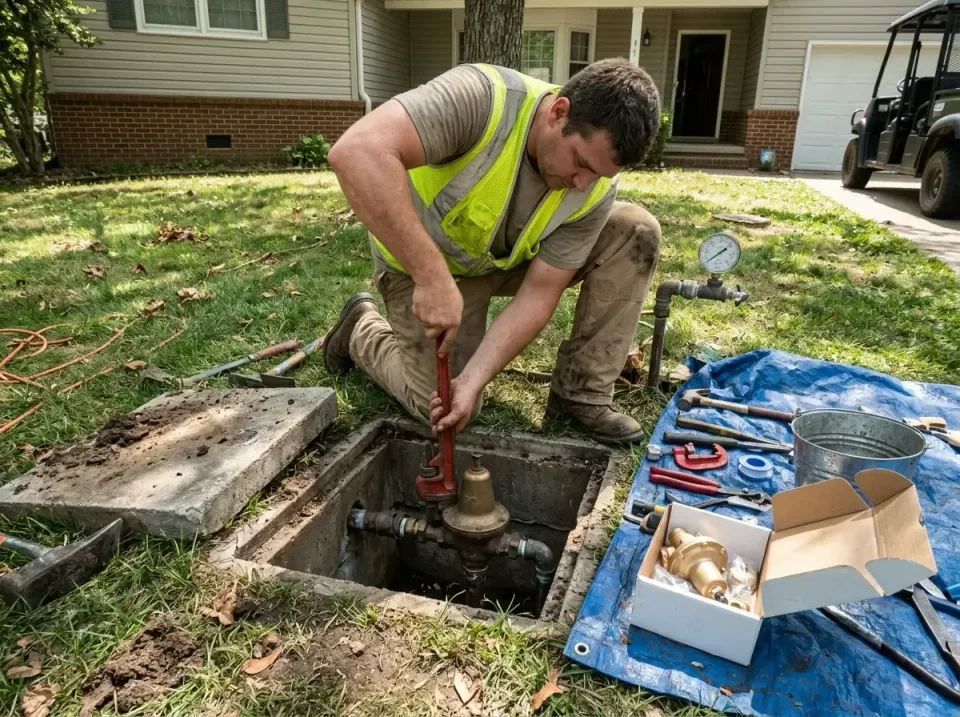
Repair is reasonable when inspection finds a correctable issue and the valve body and regulating mechanism remain serviceable. Depending on the model and condition, a plumber may clean or adjust the unit or replace a serviceable part. Replacement makes more sense when the valve is damaged, badly corroded, or no longer holds a stable setting after appropriate service.
Do not keep turning the adjustment screw to chase changing pressure. That can obscure the original symptom without fixing the cause.
A property near Killington Resort may face different service logistics than one at lower elevation; tell us about access and the equipment location when arranging an assessment. We also consider whether pressure changes only during water use or persist when fixtures are closed.
For related symptoms, see weak flow at every faucet and possible regulator trouble.
What can make pressure readings misleading?
A reading taken at one moment may not tell the whole story. We compare conditions at more than one fixture and note whether pressure changes as water runs. That helps separate a regulator problem from a supply or downstream restriction. A pressure gauge that swings sharply is a reason to investigate, not proof that the Watts valve has failed.
Lake Champlain moderates temperatures nearby, but homes elsewhere in the state can experience different seasonal conditions; that context helps us ask where pipes and the valve are located. Mountain elevations receive heavier snowfall, which can affect access to an exterior or utility-area inspection.
Around Mount Mansfield, snow-covered access may need to be cleared before a safe visit. If shower pressure drops when a toilet flushes, our guide to that pressure symptom offers another useful comparison.
When should you call a plumber instead of DIY?
A homeowner can note which fixtures are affected, whether the symptom is constant, and what the gauge reads without adjusting the valve. Stop there if diagnosis requires opening a pressurized line, replacing the regulator, or working around a shutoff that will not close. Incorrect installation can leave the system without dependable control or create a leak.
We protect the work area, confirm the likely cause, and explain the repair before proceeding. Near Rutland Downtown Historic District, an older home may call for a careful look at the surrounding piping as well as the valve; the same principle applies throughout Vermont. If you want the diagnosis documented before approving replacement, ask us to record the observed readings and explain why the existing unit can or cannot be serviced.
Which Watts Valve Repair Option Fits the Symptom?
Weak pressure at every tap calls for a different investigation than one slow faucet. The right option depends on the supply type and what testing shows.
| Option | Best for | Key detail |
|---|---|---|
| Municipal supply diagnosis | Pressure trouble across several fixtures | Confirm incoming supply and compare readings before blaming the regulator. |
| Private well diagnosis | A home supplied by a well | Identify the source first; a Watts valve is not the only possible cause. |
| Pressure regulator repair | A serviceable valve with a correctable fault | Pressure regulator connections commonly measure 3/4–1 inch; confirm the installed size. |
| Fixture-specific flow repair | One tap or shower with weak flow | Branch water lines commonly measure 1/2–3/4 inch; a local restriction may be the issue. |
For a home reached from Interstate 89, share access details when scheduling so the visit can be planned. U.S.
Route 7 also crosses communities where travel planning matters. If you are near Ben & Jerry’s Factory in Waterbury, Brattleboro Downtown Historic District, Burke Mountain, or Fairbanks Museum & Planetarium in St.
Johnsbury, provide your location and describe the symptom. Those details help us prepare for the right diagnosis, not assume a particular valve fault.
How Do You Prepare for Watts Valve Service?
A little preparation makes it easier to check the valve without delay. Keep the work area clear and tell us what changed.
-
Describe the symptom: Note which fixtures are affected and whether the pressure change is constant or intermittent.
-
Identify the supply: Tell us whether the home uses municipal water or a private well so the diagnosis starts in the right place.
-
Clear the utility area: Make the basement or utility room and the valve itself accessible before the visit.
-
Plan around weather: Spring snowmelt can saturate basements and well areas, so mention standing water and keep the equipment area safely accessible.
-
Share outage history: Summer thunderstorms may interrupt pump operation; report any recent outage if the home has a well.
-
Allow for power access: The crew may need power for diagnostic equipment; keep the work area and access point available.
If you are near Robert Frost Stone House Museum in Shaftsbury, University of Vermont in Burlington, or Marsh-Billings-Rockefeller National Historical Park, include the service location when booking so we can plan the visit.
Should You Call for Watts Valve Help in Vermont?
If several fixtures have weak flow or pressure keeps shifting, have the valve and surrounding system checked before deciding to replace parts. A reading below 40 psi is commonly considered low household pressure, while pressure above 80 psi commonly calls for pressure reduction; a measured result gives the discussion a sound starting point. We look at the evidence and explain whether repair or replacement fits the condition of the valve.
Across Vermont, inland valleys can have colder winter nights, so tell us if the valve or nearby piping is exposed to cold areas. Near Jay Peak Resort, Green Mountain National Forest, or Mad River Glen in Fayston, access and equipment location may shape the visit. For a pressure diagnosis and a clear next step, contact Vermont Plumbing Pros about Water Pressure Regulator Repair.